Yarn inventory software for weaving units.
Stock that matches the floor.
Carton-level inventory. Owned and customer-supplied yarn segregated. Weft auto-deducts from doffing entries. Reorder alerts before stock-out. No more spreadsheet reconciliation between stores and the floor.
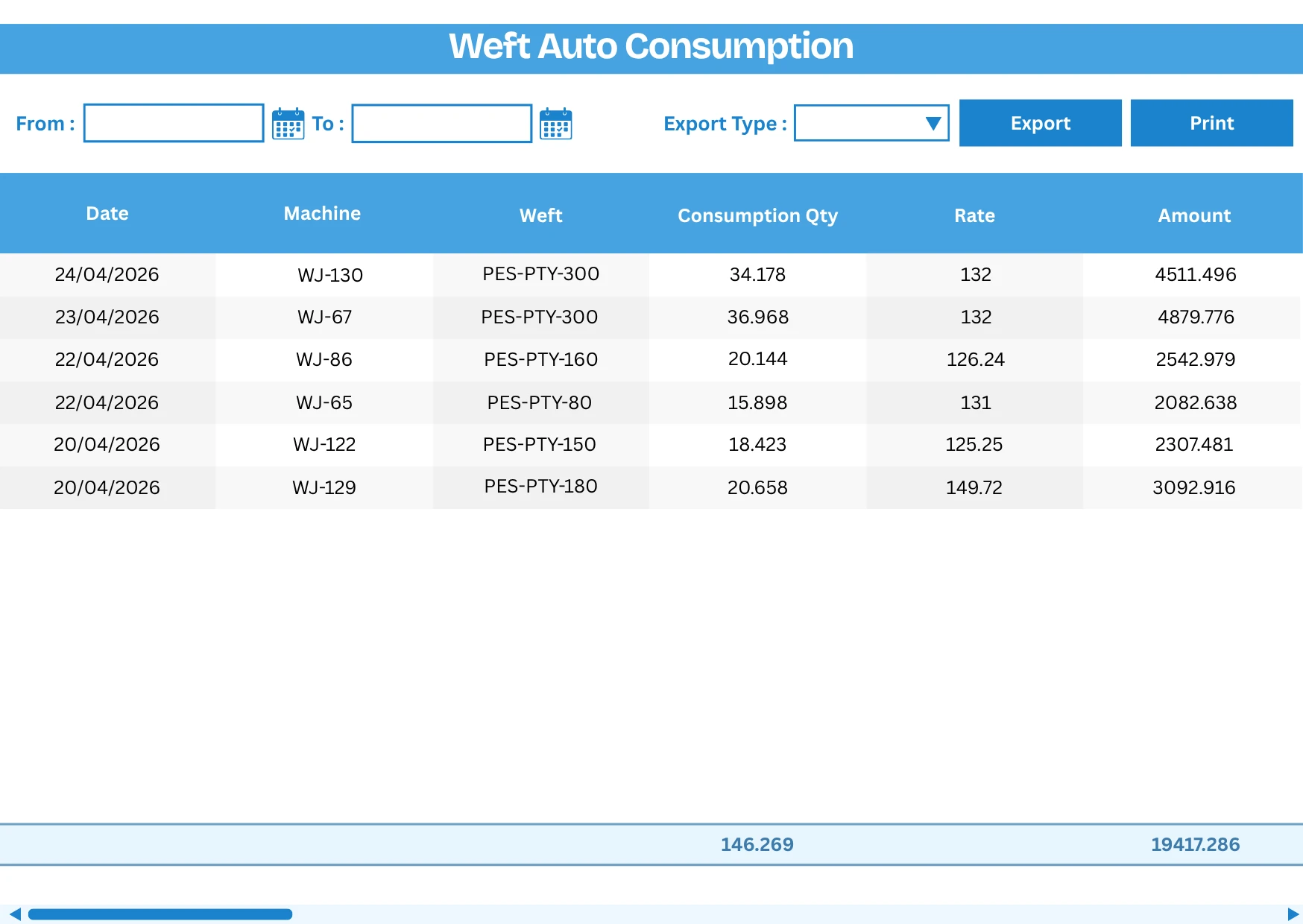
Carton-level tracking. Live deduction. No reconciliation.
Carton-level granularity
Every yarn carton logged on receipt with lot, count, weight, supplier, and HSN. Issue tracked at carton or kg level against beams, designs, or jobwork orders. Physical and system stock agree because every movement is recorded.
Owned vs customer-supplied yarn
Jobwork yarn is segregated from owned stock with returnable challans on receipt. Consumption tracks against the customer's order; balance returns at jobwork closure. No spreadsheet alongside.
Weft auto-consumption from doffing
When supervisors enter greige production on the mobile app, weft yarn deducts from inventory automatically — based on the design recipe. No manual issue voucher, no end-of-month reconciliation between the floor and the stores.
Reorder alerts ahead of stock-out
Yarn requirement for upcoming beams is auto-calculated from beam plans. Reorder alerts surface before stock runs short — typically with enough lead time to avoid emergency procurement at premium prices.
The full yarn inventory workflow, in one place.
- Carton-level receipts, issues, transfers, and physical stock counts
- Multi-godown and multi-location inventory with transfer tracking
- Owned-stock vs jobwork (customer-supplied) segregation
- Weft auto-consumption tied to design recipes
- Lot tracking with shade-batch traceability
- Reorder alerts with procurement lead time
- GST-compliant inward documentation (HSN, e-way bill matching)
- How does carton-level yarn tracking work?
- Every yarn carton is logged on receipt with lot number, count, weight, supplier, and HSN code. Issue happens at carton or kg level against a specific beam, design, or jobwork order. Each movement is recorded, so physical stock and system stock agree — eliminating the monthly reconciliation between the floor and the stores.
- Can the system handle owned and customer-supplied yarn separately?
- Yes — first-class workflow. Customer-supplied (jobwork) yarn is logged on receipt with a returnable challan and segregated from owned stock. Consumption, balance, and return are tracked independently. At dispatch, the finished fabric goes back with proper jobwork billing and GST treatment.
- What is weft auto-consumption?
- When a supervisor enters greige production at doffing, the system calculates weft yarn consumed against the design's recipe and deducts from inventory automatically. No separate issue voucher. The stores team validates exceptions, not every entry.
- How does reordering work?
- Yarn requirement for upcoming beam plans is auto-calculated. The system compares planned consumption against current stock and lead-time-adjusted reorder points, raising an alert when stock will fall short of upcoming production. Alerts go to the stores team and the owner.
- Does it handle different yarn count systems?
- Yes. The yarn master stores both the count value and count system (Ne / Tex / Denier). All conversions and calculations apply the right constant automatically. No manual conversion errors.
Continue with related pages.
Weft yarn deducts automatically when greige production is entered.
Read →How yarn flows from beam planning through doffing to dispatch.
Read →Carton-level tracking, customer yarn segregation, weft auto-consumption.
Read →The formula, a worked example, three operational tips.
Read →What weft is and how it consumes during weaving.
Read →How customer-supplied yarn workflows differ.
Read →Want to see yarn inventory running on a unit like yours?
Send your loom count and current setup. We'll show you the screens and walk through weft auto-consumption.